Battery Life Saver (BLS)

Battery Life Saver (BLS)
Battery Life Saver

Wednesday, December 14, 2011

Extend the Life of Your Golf Cart or Other Lead-Acid Batteries 2 – 3 Times?

About 80% of all lead acid batteries fail prematurely because of a buildup of lead sulfate on the plates  that causes the battery to become unusable.


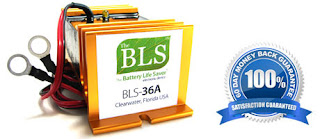
The Battery Life Saver is a patented, electronic desulfator that dissolves this buildup, restoring the batteries to their full capacity.

Now, there is no need to buy new batteries. The Battery Life Saver can help extend your battery life two to three times. Guaranteed!

It also prevents slowdown, restores power and performance.

The Battery Life Saver reduces consumption of water and maintenance trouble in your golf cart batteries, and best of all, we offer a 60-Day MONEY-BACK Guarantee!!

That’s right. A money-back guarantee.

To order your Battery Life Saver today, visit our secured website at: www.buybls.com.


ORDER YOUR Battery Life Saver TODAY!

Wednesday, November 23, 2011

Understanding Batteries and the Battery Life Saver (BLS) Electronic Device

The Battery Life Saver electronic device will extend the life of any lead-acid battery and can rejuvenate “dead” batteries to a like new condition. But how does it work? To understand the technology behind the BLS, we must first understand how a battery works.


How A Battery Works

In a normal battery we have three basic elements: one plate made of lead, an electrolyte of sulfuric acid and another plate made of lead oxide. When the battery is discharged, the sulfuric acid in the electrolyte reacts with the lead and lead oxide releasing electricity, forming lead sulfate. This leaves a watery electrolyte solution. When a battery is completely discharged, what is left is lead sulfate and water. When you recharge the battery, the electrical current causes the lead sulfate to break apart. This returns the system to the original elements of lead and lead oxide on the plates and sulfuric acid in the electrolyte, for the most part.

What’s the problem? Why do batteries fail?

When the battery is recharged, a small amount of lead sulfate maintains its sulfate configuration (sulfate crystal).

These sulfates crystals cannot be reconverted using a regular electric current. Every time the battery is discharged, more of these crystals are produced and the electrolyte solution becomes more watery. Like layers of snow on a garden they continue to accumulate until you can no longer see the garden. These crystals interfere with the flow of electricity in and out of the battery. The battery will take longer to charge and a charge will last less time. A perfectly good battery will seem dead because lead sulfate has built up on the plates.

The BLS is the Solution

The Battery Life Saver electronic device solves this problem by dissolving the buildup of lead sulfate crystals. The BLS sends a radio signal through the battery, targeting the lead sulfate crystals (even those that could not be dissolved by recharging), converting them back into lead and sulfuric acid. Each crystal is like a tiny radio receiver. In fact, when the radio was invented, a lead sulfate crystal was used for the receiver.

The BLS action gradually restores the battery back to its original condition and allows the electrical charge to be drawn from the battery.

Other Desulfators

Electronic and chemical desulfators have been on the market for years. How is the BLS different? The biggest difference is the BLS’s ability to target the whole range of sulfates that accumulate on the lead plates. As discussed above, regular electric current does not have the ability to do this. Electronic desulfators (commonly known as pulsers) send a high amount of voltage for a short period of time throughout the battery to knock down the crystals (similar to overcharging). They are unable to dissolve all the different types of sulfates. You can get some initial apparent improvement but the continued use of the other desulfators that knock down crystals cause two negative effects on the battery:

1.) If you continue to use the pulser, the crystals will continue to accumulate at the bottom of the battery which can eventually cause a short cell.
2.) The plates will become thinner and the sulfuric acid will become weaker because any lead sulfate that falls to the bottom of the battery cannot be recovered.
The Battery Life Saver electronic device dissolves the lead sulfate crystals that are covering the plates, converting them back into the original elements. It rejuvenates the sulfuric acid solution as well as the lead plates.

Get your Battery Life Saver TODAY!!  Order now at: http://buybls.com

Sunday, November 6, 2011

Stretching Your Golf Cart Battery Dollar


Battery prices are rising!

To save money, a good strategy is to make batteries last as long as possible.

Golf cart owners today want batteries to last longer before they have to replace them. They want them to last longer on a charge. Golf cart owners today don’t just need carts that last 18 holes on the golf course. They are shoppers and commuters who use golf carts for errands, visiting and just plain getting around town. They want to go the distance and back.

The problem is, over time, battery operated golf carts slow down. They don’t go as far; they don’t hold as much charge. Lead sulfate builds up on the battery plates. In fact, 75% -80% of lead acid batteries — the kind used in golf carts — fail prematurely because of the formation of lead sulfate crystals on the plates. If batteries sit in disuse, it makes matters worse, as crystal buildup makes batteries unusable in a matter of months, especially in hot weather.

Chuck Van Breemen invented Battery Life Saver to protect the environment by extending battery life and reducing the power needed to recharge batteries. It is an electronic device that easily attaches to a battery bank. You clip it on, then forget it; it will keep lead sulfate from forming. It also can be used to restore “dead,” sulfate-ridden batteries to their original condition.

The device uses Wave2 Battery Restoration Technology, which dissolves the lead sulfate crystals, restoring electrical flow. If you are technically inclined, Wave2 is a “square wave,” with enough power and variability to excite all the frequencies of lead sulfate crystals and convert them back to lead and sulfuric acid. This restores the battery to its original condition and allows the electrical charge to be drawn from the battery.

Sterling R. of Sun City Center, Florida, drives two miles every day to the golf course, plays 18 holes and drives back. He put new batteries in his golf cart just before he bought Battery Life Saver. Over the course of his trip, his fuel gage would go down to l/2 full. After he began using Battery Life Saver, his gage only went down to 3/4 full. This means he is using 1/4 of the power available in the battery. Great savings all around!

Today golfers and short distance golf cart drivers are stretching their dollars by using Battery Life Saver. It can be used as well on cars, tractors, trucks, lawn mowers and airplanes.

Get your Battery Life Saver TODAY!!  Order now at: http://buybls.com

Monday, October 24, 2011

8 Ways to Improve Lead-Acid Battery Life

Lead-acid batteries have become a necessity in today’s society. Our cars, trucks and recreational vehicles all use batteries to start their engines. Forklifts, electric chairs, and off-grid power systems need lead-acid batteries to operate. Lead-acid batteries can be a hassle to replace and expensive, with some batteries costing up to $5000. To get the most out of your lead-acid batteries, follow these simple procedures.


  1. Regularly charge your batteries. Let them fully charge before disconnecting the charger.
  2. Especially in cold environments, be sure to keep your batteries charged. If you leave an uncharged battery exposed to freezing temperatures, the battery will freeze and crack.
  3. In warm environments, store cars and batteries in cool places or at least away from direct sun exposure.
  4. Water batteries regularly if they are the unsealed type. Use distilled water only.
  5. Do not equalize or overcharge your batteries as it deteriorates the integrity of the plates.
  6. Do not use solid or liquid additives in your batteries.
  7. PLEASE, DO NOT empty out the fluid in the battery and replace it with new battery acid. It is very harmful to our environment and it is not effective in the long term.
Use a good electronic desulfator that will help to eliminate hard sulfates from the plates. The life and performance of a battery can be increased be keeping the hard sulfates off the plates.

The Patented, Battery Life Saver has been designed especially for that purpose.

Whether you have a golf cart, electric vehicle, fork lift, boat, farm equipment, solar/wind application, truck or RV, The Battery Life Saver has a model that will work for you.

Check out our website at: http://buybls.com

For more information, you can call (800) 993-7886 Toll-Free.

Monday, October 17, 2011

How to Get the Most from your Lead-Acid Battery

By Emanuel Hillmann
We all benefit from using lead-acid batteries. Our cars and golf cars will go nowhere without them. Many niceties of civilization maintained outside electrical grid systems like a refrigerator or TV in our RV would not be possible without batteries. Of course, wind and solar systems depend on battery banks. Those batteries can cost us a pretty penny to replace and most of the time last way below their supposed life expectancy.


How do I get the most out of my batteries?
To better understand what to do we will need to answer a couple questions:
a. What is a battery? A battery is a device in which chemical energy is transformed into electrical energy. That energy can be used in a controlled manner.
b. How does a battery work? In a normal battery we have three basic elements: one plate made of lead, an electrolyte of sulfuric acid and another plate made of lead oxide. When the battery is discharged, the sulfuric acid in the electrolyte reacts with the lead and lead oxide releasing electricity, forming lead sulfate. This leaves a watery electrolyte solution. When a battery is completely discharged, what is left is lead sulfate and water. When you start recharging the battery, the lead sulfate is broken apart by the electric current. This returns the system to the original elements: lead and lead oxide on the plates and sulfuric acid in the electrolyte, for the most part.
We said for the most part because an incomplete recharge is going to leave behind some lead sulfate. The next time you use the energy from the battery, the newly formed sulfate is going to attach to the left over sulfates making stronger sulfates. The problem is that a normal battery recharge is not going to be able to break them down completely. So you will have more and more sulfates that now are not breaking up and gradually are shortening the life of your batteries.
What to do?
First make sure you recharge your batteries completely and regularly even if you do not use your vehicle.
You can use a good electronic desulfator. It can dissolve the otherwise hard to eliminate sulfates, extending the battery life.
After testing many powders and liquids sold to eliminate sulfates, I would not recommend using those kinds of substances.
Overcharging, also called equalizing is another action that is not recommended. It will end up killing your batteries in the long run despite any apparent immediate improvements.
As we mentioned earlier there are chemical reactions charging and discharging batteries. Heat accelerates those reactions causing a battery to discharge faster. It is important to protect your batteries as much as possible from high temperatures. It is better to store in a cool place. Park your cars in a shadowy place and avoiding as much as possible the direct sun.
If heat can dramatically reduce the battery life, ice can destroy it completely. Do not ignore icy weather. If you are going to leave your car or golf car for months in a place that can be hit by extensive freezing temperatures or you expect a freeze, make sure to fully charge your batteries before the freezing temperatures start. If you are going to leave for months at the time a trickle charger is very useful to maintain batteries in a good condition. The risk of a discharged battery hit by freezing temperatures is that the water formed by the discharge of the battery when frozen can crack the battery, destroying it.
Talking about water, if your batteries are the unsealed types make sure to regularly water them.
The worst enemy of your batteries is neglect. Batteries well cared for last two times longer than neglected ones.
Don’ts
1. Do not equalize and/or overcharge your batteries.
2. Do not store your batteries in hot places or under direct sun exposure.
3. Do not use solid or liquid additives in your batteries.
4. Do not neglect to water and only use distilled water. Any other water contains minerals that are bad for your battery.
5. Do not neglect to charge regularly.
6. Do not expose directly your batteries to very low temperatures to prevent any risk of cracking.
Do’s
1. Regularly charge your batteries. Let them to get fully charged before disconnecting the charger.
2. Use a good electronic desulfator that will help to eliminate hard sulfates from the plates.
3. Store cars and batteries in cool places or at least away from direct sun exposure.
4. Water batteries regularly if they are the unsealed type using distilled water.
5. Protect batteries from being directly exposed to extreme cold weather.
These simple rules will help you to get the most out of your batteries.
A simple desulfator device called a Batter Life Saver can help increase the life of your batteries dramatically.  For less than the cost of 1 replacement battery, the BLS can protect your battery investment and give your batteries a whole new useful life. Order today at: http://buybls.com

Friday, October 14, 2011

Reviving Dead Golf Cart Batteries


The Battery Life Saver electronic device can be used to revive a dead battery that has accumulated too much sulfate build up or has been allowed to sit unused for a long period of time.
 However, it will not work on a battery that has a shorted or open cell. 
This procedure works for a car-auto, deep cycle, marine and all other lead acid battery applications.

  1. A dead battery is one that will not hold a charge, and in some cases, they are unable to take a charge.
  2. It can take several days to a couple weeks to revive a dead battery, depending on how far south it is and how often you cycle(charge and discharge) the battery with BLS attached.
  3. For a 12 volt battery, you will need the BLS-12/24-B and a good automotive battery charger, preferably with a rating of 6 to 10 amps. For batteries that cannot take a charge, it is best to use an old fashioned battery charger, not one of the newer high tech Smart Battery Chargers . The newer smart battery chargers will not turn on if the voltage of the battery is too low. This does not mean that the battery is completely dead, just that the charger will not turn on. If you do not have a manual charger available, you can jump start the bad battery(just like jumpstarting your car battery) to get the battery voltage high enough for the smart charger to turn on (contact us for more information on this procedure).
  4. The key to this procedure is to cycle (charge and discharge) the battery with the BLS attached. The BLS gradually dissolves the sulfate crystals with every cycle. The Battery Life Saver works from the power of the battery. You can either let the BLS discharge your battery or add some type of load(i.e. a light) to help discharge the battery.
  5. Step 1: Connect both the BLS and the charger to the battery, paying attention to the polarity.
  6. Step 2: Charge the battery with the BLS attached until the voltage is at least 12 volts or completely charged.
  7. Step 3: Leave the Battery Life Saver connected to the battery without the battery charger for a period of time(if it is a single 12 volt battery, 20 hours should be enough time to discharge with the BLS). DO NOT LET THE VOLTAGE GO BELOW 9.5 VOLTS.
  8. Step 4: When the battery voltage is between 9.5 and 10 repeat step 2 and 3.
  9. Work back and forth between 2 and 3 until the battery comes back up to operational condition. If you cycle(charge and discharge) the battery every day with the BLS connected, the battery should come back sometime between 3 days and 2 weeks.
To Order your BLS (Battery Life Saver) please visit our website at: http://buybls.com

    Tuesday, October 11, 2011

    Can Golf Carts Help with the Energy Crisis?

    There is a new trend; people are looking back to alternative modes of transportation.  Gas prices are constantly fluctuating but in general keep going up. People are starting to see that transportation that depends on oil is not going to solve our problems. Sales of bicycles, golf cars and scooters are going up. Sales of big gas guzzling cars are down.


    Let’s take a closer look. Will golf carts help with the energy crisis or are they a fad that will go away?

    Today golf cars are more popular than ever. Since their introduction in 1951 many changes have occurred. Golf carts can come with all sorts of accessories, sometimes sporting the brands and looks of big luxury cars, their cost range from $1500 to $5000 and up to $30.000 and more for the luxury models but in general their pricing is accessible for the average household.

    To Order your BLS (Battery Life Saver) please visit our website at: http://buybls.com 

    To begin we are going to correct the misnomer of “cart”, per standard z130.1 of American National Standards Institute (ANSI), "carts" are not self-propelled. The official name will then be “golf car” or “buggy”. 

    Most of golf cars operate with a lead–acid battery system that range from 36 to 72 volts. Their average speed is around 23 mph. A golf car is generally used by golfers for the 18 holes run (6500-7000 yards) but they can run up to 40 miles per charge. 

    There are many communities around the country where golf cars are used to go to the supermarket, drugstore, church and to do errands. Golf cars are compact and easy to drive and park. The Villages in Central Florida is a great example of a golf car community. It is a dynamic retirement community designed with golf cars in mind. You can see golf cars on every corner and every household has at least one. The cost to fully charge a golf car goes from about $0.40 to a less than a dollar per day depending on the system’s voltage and the condition of the batteries.

    So far so good, golf cars are environment and user friendly, relatively inexpensive and energy efficient.
    What is the downside? 

    Very few towns are golf car friendly, making golf car travel more difficult. Most towns have minimum speed limits that are above golf car speed and require turn signals, tail and head lights.

    For many friends of speed, well, golf cars do not give them that rush. You can only use golf cars inside your community.

    There is a real problem. On talking to some golf car owners we run one by one onto the same problem. After a couple of years the golf car slows down. All the sudden you find yourself “pushing” your car to make it back home.

    Behind this terrible problem is usually battery failure. Although made to last 5-10 years, batteries tend to die prematurely because of sulfate buildup. Sulfate is a normal byproduct of the chemical reaction that happens inside lead-acid batteries. Every time the battery is charged and discharged more of those crystals are deposited on the plates. Like layers of fine snow on a garden they accumulate until you can not longer see the garden.

    These crystals interfere with the flow of electricity in and out the battery. Batteries will take longer to charge and the charge will last less time. 

    A good performance for a set of batteries in conditions like Florida, Texas, Nevada, California or Arizona last about 3 years. Then the owners have to experience slow downs until it is unbearable. At that point golf car owners have to go through the “painful” experience of replacing batteries, a $600-$800 expense.

    The solution

    Towns are going to have to embrace change and learn to accommodate the new street users. Modification of golf cars to comply with current requirements is not very expensive. In any case, residential areas should not have vehicles moving above 25 mph. There are going to be more and more people using bikes, golf cars, scooters and small electric cars. This trend is not going away any time soon.

    Now, regarding the huge problem with battery life, here are simple things you can do to maintain and extend the life of your batteries:

    1) Regularly charge your car. As much as possible keep your golf cars fully charged. Make sure your charger is a smart charger that will recognize when batteries are fully charged, it protects them from overcharging. Overcharging is deadly to your batteries.

    It is an effective way to kill batteries prematurely.

    2) Try as much as you can to park your golf car in a shaded area as heat tends to exacerbate the sulfate accumulation.

    3) Regularly check the water level on your batteries. Use only distilled water to replenish them.

    4) Use a desulfator to control the accumulation of lead sulfate. The Battery Life Saver™ electronic device is the most effective desulfator in the market. It targets the sulfate crystals, breaking them down and rejuvenating the battery. Using this device will extend the life of batteries two to three times, making golf cars a good business for all. To Order your BLS (Battery Life Save) please visit our website at: http://buybls.com

    There is a bright future for golf cars. They can help us to save lots of money and help break the dependency on oil.

    To Order your BLS (Battery Life Saver) please visit our website at: http://buybls.com